Bottom Line
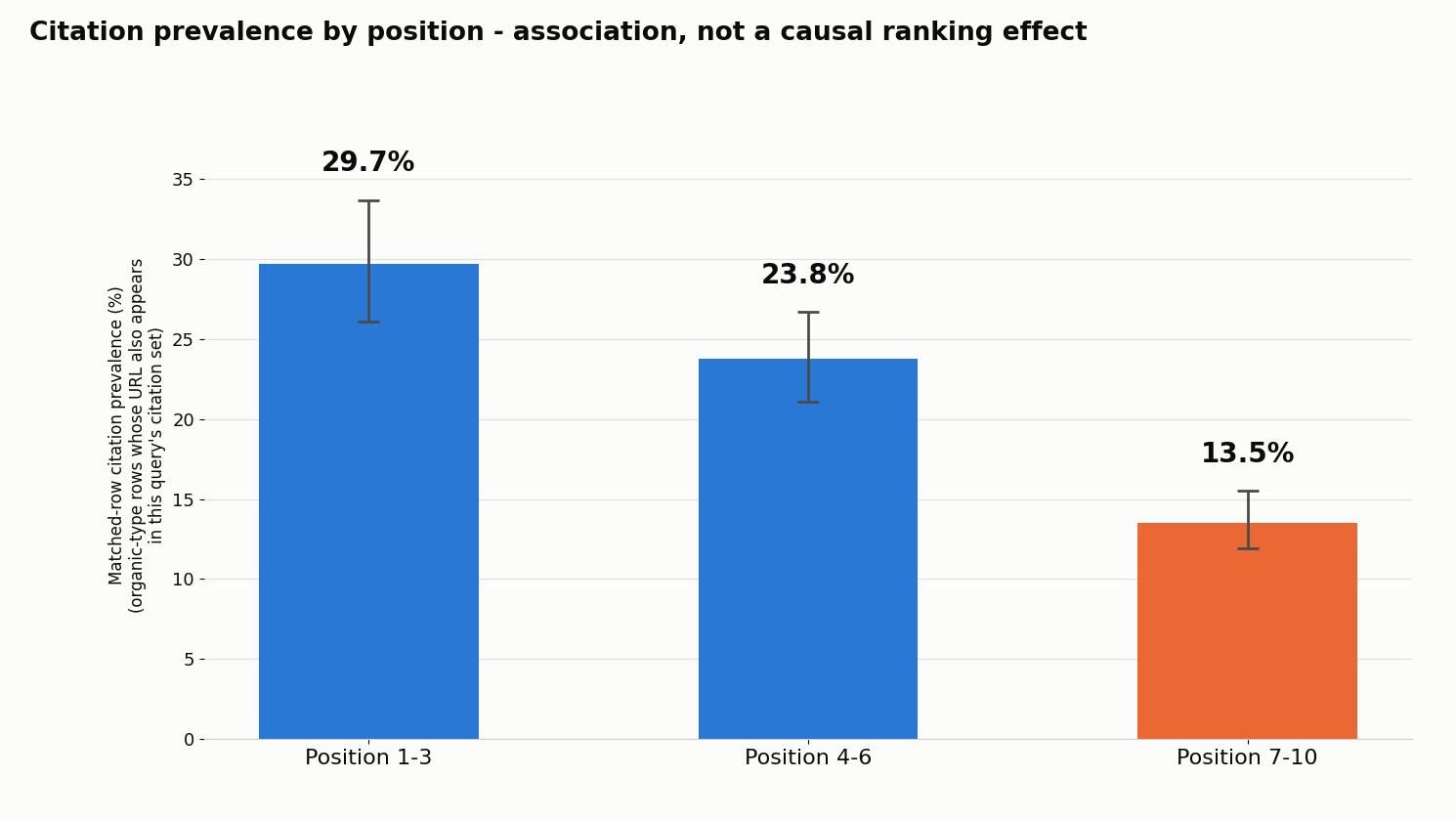
Across 3,875 organic-type result rows collected for 500 query-market pairs (of 506 requested), 776 rows - 20.03% - carried a URL that also appeared in that query's AI Overview citation set. Citation prevalence was 29.7% in SERP positions 1-3, 23.8% in positions 4-6, and 13.5% in positions 7-10. These are associations observed in one cross-sectional snapshot, not estimates of what would happen if a specific page moved rank. Raw authority-metric quartile bins were non-monotonic and correlated with position; after adjusting for position and market, link-count metrics (backlinks, referring domains, URL Rating) retained a statistically meaningful association with citation, while Domain Rating's raw "floor effect" did not hold up on its own. This study supports a measurement framework for tracking AI Overview citation patterns - it does not establish a causal ranking threshold, an optimal target position, or a comparison between content formats.
This piece is the authority-metrics companion to CoreAEX's The AI Overview Click Tax in B2B SaaS Search - that study measures how much organic click share survives once an AI Overview appears; this one asks which page-level metrics associate with actually being cited inside one.
What This Study Supports, and What It Does Not
Supports: descriptive, reproducible prevalence rates and statistical associations within this snapshot - for example, "citation was more prevalent among positions 1-6 than 7-10 in this sample" (query-cluster bootstrap difference 16.2 points, 95% CI 12.8-19.8, for positions 1-3 vs. 7-10).
Does not support: a claim that moving a specific page from position 7 to position 5 would cause it to be cited; a claim that position 6 is an "optimal target"; a claim that backlinks or referring domains have "no effect" or a "threshold" effect in a causal sense; or a claim that video content causally outperforms article content for citation. The data are a single-snapshot cross-section - no page was observed before and after a rank or content change.
Methodology
Revision notice, round 1 (pre-publication).
The first draft of this manuscript was audited against its own underlying data. That audit found every specific descriptive number reproduced correctly from the supplied CSV, but flagged nine issues: an incorrect reconciliation claim, undefined position semantics, a row-vs-URL denominator mismatch, unaudited citation-level data, undisclosed non-random missingness, mislabeled quartile bins, unadjusted authority comparisons, causal/optimization language not supported by a cross-sectional design, and imprecise study-strength language. The next revision corrected all nine.
Revision notice, round 2 - this version (pre-publication).
A follow-up audit re-checked the round-1 revision and confirmed it: 506 requests reconcile to 500 usable pairs, and every SERP row, citation, position rate, and adjusted model reproduced. It flagged four remaining precision issues: the "outside organic top 10" framing overstated what an unmatched citation proves, given that no query returned a full 10 organic-tagged slots; two authority-bin group sizes are sensitive to a single-row tie-boundary convention that wasn't documented; the analysis script and raw source data referenced as "published" had not actually been delivered; and a blanket cross-market claim went beyond what was separately tested. This version corrects all four and adds the raw Ahrefs batch responses to the download package for full reproducibility.
506 SERP Overview requests (305 US, 201 UK) across a B2B SaaS/martech query set (the 435-keyword master list from the earlier AI Overview Click Tax study, reused verbatim, plus 71 supplemental keywords), requesting organic, ai_overview, and ai_overview_sitelink result types in a single call per query. Of the 506 requests, 500 query-market pairs returned at least one organic-type row; 6 returned none and are excluded from every table, logged with reason in the query manifest rather than silently dropped. For every organic-type row, this study checks whether the same URL also appears among that query's AI Overview citation entries, after excluding 291 entries that were unresolvable Google redirect trackers rather than real destination URLs; the reverse check - whether a citation URL matches any organic-type row returned for that query - produces the figures on citations not matched to a measured organic-type slot (see Finding 3).
Ahrefs' position field marks a slot's position in the rendered SERP; it is not a guarantee that ten organic results exist or were captured. No query-market pair in this dataset returned 10 organic-tagged rows (observed range: 6-9); position 1 specifically is organic-tagged in only 134 of the 500 usable pairs, most often because the AI Overview itself occupies that slot. "Organic top 10" in this report means organic-type SERP slots within positions 1-10, not a guaranteed ten-item organic list.
| Metric | Value |
|---|---|
| Requests sent to Ahrefs | 506 (305 US, 201 UK) |
| Query-market pairs returning organic-type rows | 500 (303 US, 197 UK). 6 pairs returned zero organic-type rows and contribute no data to any table |
| Unique keyword strings | 360 (a keyword can be sent for both US and UK, and the 506-request keyword pool includes near-duplicates across markets) |
| SERP pull type requested | organic + ai_overview + ai_overview_sitelink, top 10 SERP positions |
| Fields captured per result | URL, position, type, Domain Rating, backlinks, referring domains, URL Rating. Title was requested but not retained by the collection pipeline |
| Organic-type rows analyzed | 3,875 (slot level). Range 6-9 rows per pair; no pair returned 10 |
| Citation entries returned | 2,523 total (408 no-URL root markers + 291 unresolvable redirects excluded → 1,824 usable citation URLs) |
| Markets | United States and United Kingdom, English |
| Data pulled | September 1, 2026 |
| Total Ahrefs API spend for this pull | Approximately 83,304 units (113,812 → 197,116 of the 400,000 monthly Standard-plan workspace budget) |
| Analysis unit | Two units are reported and labeled throughout: slot-level (one row per organic result) and page-level (one unit per distinct query-URL pair). They are not interchangeable |
Data Lineage and Quality
Denominator reconciliation. 776 organic-type rows are slot-level citation matches (one row per SERP slot). 24 of those involve a URL appearing twice within the same query at different positions; deduplicating to distinct (query, URL) pairs gives 775 page-level matches. Both numbers are reported in this study; neither should be read as the other.
Missing authority metrics are not random. Backlinks and referring domains are missing on 504 of 3,875 rows (13.0%). Citation prevalence among those rows is 3.77% versus 22.46% among rows with the metric present - a large gap - and the missing rows are concentrated on specific domains (google.com accounts for 129 of the 504; zapier.com, reddit.com, youtube.com, and several SaaS vendor domains account for most of the rest). Every quartile or mean built from these metrics implicitly conditions on "Ahrefs returned a value," which is not the same population as all 3,875 rows.
Quartile bins contain ties and uneven group sizes. These are approximate quantile bins with ties retained, not four equal-sized groups. URL Rating group sizes are 1,731 / 294 / 891 / 959; Domain Rating groups are 1,035 / 1,223 / 665 / 952. Cutpoints and exact sizes are reported next to every rate in this study rather than left implicit.
The citation-level data behind the headline citation count is published in full. The citation-rows file contains all 2,523 AI-Overview-typed entries Ahrefs returned, including the 408 structural no-URL root markers and the 291 excluded redirect trackers, kept rather than deleted so a reader can attempt independent resolution. This makes the 1,824 usable citation URLs, 775 matched-to-organic-slot, and 1,049 not-matched-to-organic-slot figures independently auditable.
Quartile bin boundaries follow a stated, right-closed convention. A row falls in a quartile if its value is less than or equal to that quartile's cutpoint (Q1: v ≤ P25; Q2: P25 < v ≤ P50; Q3: P50 < v ≤ P75; Q4: v > P75), with cutpoints taken as order statistics of the observed values rather than interpolated. Exactly one row sits precisely on the Q3/Q4 cutpoint for backlinks (1,398) and for referring domains (353); under this convention both land in Q3. A reader applying the opposite convention (cutpoint value assigned to Q4 instead) would compute backlinks Q3/Q4 as n=838/n=843 (rates 23.03%/24.08%, versus this report's n=839/n=842 at 23.00%/24.11%) and referring domains Q3/Q4 as n=834/n=843 (25.42%/23.72%, versus n=835/n=842 at 25.51%/23.63%). Both conventions are defensible; neither changes any conclusion in this report by more than 0.1 percentage points.
The title field was requested but not retained. The original collection pipeline asked Ahrefs for a title field per result but the stored output does not contain it. Restoring it would require re-pulling all 506 requests, approximately 83,000 additional Ahrefs units, and was deferred for this revision - the SERP-rows file carries an empty title column rather than a fabricated one, and this gap is disclosed rather than hidden.
Finding 1: Citation Prevalence by Position
Positions 1-3 (29.7%) and 4-6 (23.8%) show meaningfully higher matched-row citation prevalence than positions 7-10 (13.5%). Query-cluster bootstrap differences: 16.2 points (95% CI 12.8-19.8) for positions 1-3 vs. 7-10, and 10.3 points (95% CI 7.7-13.0) for positions 4-6 vs. 7-10 - both intervals exclude zero, so the association is unlikely to be sampling noise within this snapshot. This is a within-sample association: pages currently ranking 1-6 are more often also cited than pages currently ranking 7-10. It does not show that ranking improvement causes citation, since no page in this dataset was observed to change rank.
Finding 2: Authority Metrics - Raw Bins vs. Position-Adjusted Association
Raw bins show the pattern an unaudited draft of this study called a "threshold effect": the bottom bin runs several points below bins 2-4 for every metric, and Domain Rating additionally falls back down in the top bin.
| Quartile | Domain Rating | Backlinks | Referring domains | URL Rating |
|---|---|---|---|---|
| Q1 (lowest) | 17.3% (n=1,035) | 17.8% (n=876) | 17.1% (n=890) | 14.8% (n=1,731) |
| Q2 | 22.1% (n=1,223) | 25.2% (n=814) | 24.0% (n=804) | 24.1% (n=294) |
| Q3 | 24.1% (n=665) | 23.0% (n=839) | 25.5% (n=835) | 25.7% (n=891) |
| Q4 (highest) | 17.5% (n=952) | 24.1% (n=842) | 23.6% (n=842) | 22.8% (n=959) |
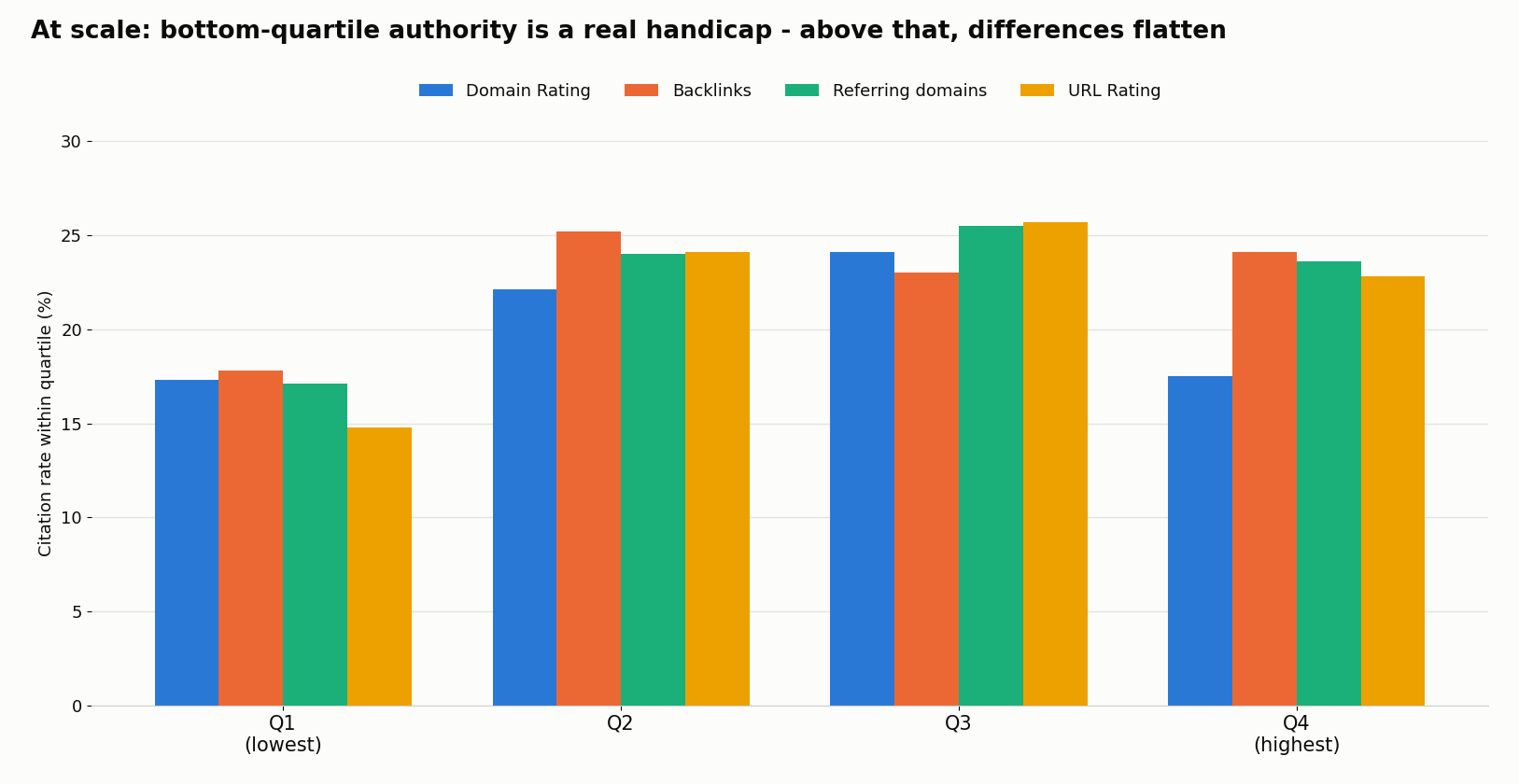
But higher-authority pages in this sample also tend to rank better, and position independently predicts citation (Finding 1) - so the raw bins conflate authority with position rather than isolating either one. To separate them, this study adds a position- and market-adjusted logistic regression for each metric: citation as a function of an above-bottom-quartile indicator, position bucket, and market, with standard errors clustered by query, since rows from the same query are not independent observations.
| Metric | Adjusted OR | 95% CI / significance |
|---|---|---|
| Domain Rating | 1.17 | 0.95-1.45 (not significant, p=0.14) |
| Backlinks | 1.25 | 1.01-1.55 (p=0.04) |
| Referring domains | 1.35 | 1.09-1.68 (p=0.006) |
| URL Rating | 1.65 | 1.37-1.99 (p<0.001) |
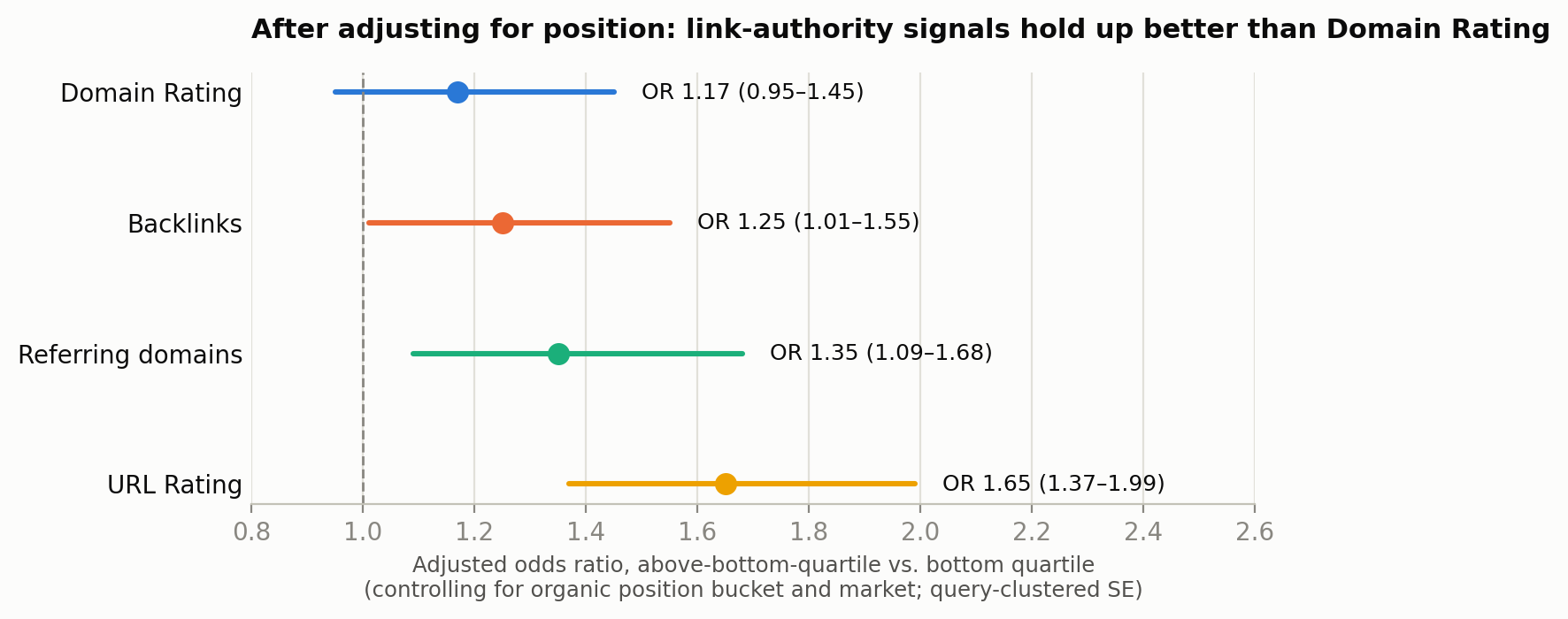
After this adjustment, Domain Rating's raw "floor" does not hold up as a distinct effect (OR 1.17, 95% CI 0.95-1.45 - the interval includes 1). Backlinks, referring domains, and URL Rating retain a statistically meaningful association even after controlling for position and market, with URL Rating showing the clearest signal (OR 1.65, 95% CI 1.37-1.99). The corrected reading: this snapshot's raw Domain Rating pattern is largely explained by its correlation with ranking position, while page-level link-authority metrics carry an association with citation that isn't fully explained by position. This is still an observational, cross-sectional association, not a causal test - it has not been shown that adding backlinks to a specific page would raise its odds of citation.
Finding 3: Citations Not Matched to an Organic-Type Result in SERP Positions 1-10
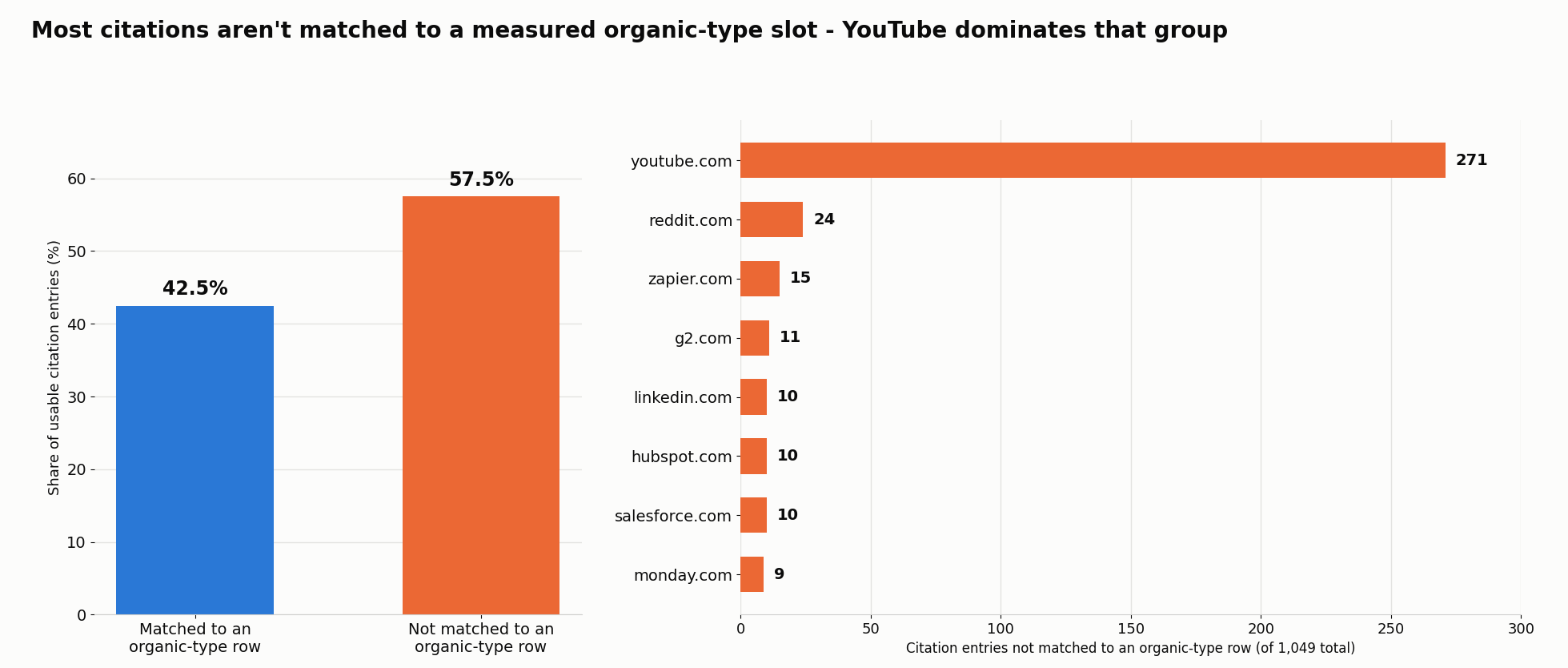
Of 1,824 usable citation entries, 1,049 (57.5%) did not match an organic-type result occupying Ahrefs SERP positions 1-10 for the same query. Citation therefore did not require occupying one of those measured SERP slots. Because each usable query returned only 6-9 organic-type rows rather than a full ten (see Methodology), this analysis does not establish whether an unmatched cited URL ranked, or would have ranked, among the first ten ordinal organic results - only that it did not occupy a slot Ahrefs tagged organic in this pull. YouTube alone accounts for 271 of the 1,049 unmatched entries (25.8%) - more than ten times the next domain (reddit.com, 24).
Finding 4: Market Comparison
US and UK matched-row citation prevalence: 19.3% (US, 443/2,299) vs. 21.1% (UK, 333/1,576). Both markets show higher matched-row citation prevalence in positions 1-6 than in positions 7-10. Unmatched-citation prevalence, the Finding 3 measure, was also similar between markets: 56.7% in the US (579/1,021) and 58.5% in the UK (470/803). This is a descriptive comparison on these two specific measures, not a test of a systematic market difference across every finding in this report; a dedicated matched-pair market-comparison design with adjustment for query type would be needed for that.
Limitations
- Cross-sectional, single snapshot. No page in this dataset was observed before and after a change in rank, links, or content format. Every finding here is an association within one point-in-time measurement, not a causal test.
- Single vertical, two markets. B2B SaaS/martech, US and UK, English-language - findings may not generalize to verticals where AI Overviews lean more on structured data, reviews, freshness, or local intent.
- Title field not captured (see Data Lineage) - a reader auditing the SERP-rows file cannot visually distinguish result types beyond the
typetag without following the URL. - Same-URL matching can undercount a page cited under a different URL variant (tracking parameters, AMP, mobile subdomain) as unmatched when it functionally is the same page.
- 291 unresolvable Google redirect URLs were excluded from citation analysis; if any pointed to a genuinely new, uncounted domain rather than a duplicate of an already-counted citation, the true citation total is a slight undercount.
- 71 of 506 requests (14%) are newly added supplemental keywords, filtered to the same relevance criteria as the original 435-keyword set but not independently volume-validated the same way.
- No prospective power analysis was run before data collection; sample size was set by available Ahrefs budget, not by a target minimum detectable effect.
- This study and the separate AI Overview Click Tax study overlap substantially in query set and, in places, in underlying pull data. They should be read as two related analyses of a shared or overlapping sample, not as independent measurements.
- The adjusted logistic model controls only for position bucket and market; it does not control for query intent type, content format, or other confounders that could also explain the authority association.
What This Means in Practice - Framed as Hypotheses, Not Conclusions
The recommendations below are hypotheses this snapshot is consistent with, not tested conclusions - they would need longitudinal or controlled follow-up (tracking the same pages over time as their rank or link profile changes) to confirm a causal effect.
- Monitor citation prevalence by position band. This snapshot associates positions 1-6 with higher citation prevalence than 7-10. Whether moving a specific page into that band causes a citation increase is untested.
- Treat backlinks, referring domains and URL Rating as worth continued tracking; treat Domain Rating with more caution. After adjusting for position, page-level link metrics retained a measurable association with citation; Domain Rating's raw pattern was largely explained by position. This does not establish that acquiring more backlinks would raise a page's citation odds - only that, in this snapshot, pages with more of them were somewhat more likely to be cited independent of rank.
- YouTube's share of unmatched citations (Finding 3) is worth further investigation, though a dedicated content-format comparison (matched articles vs. videos targeting the same query) would be needed to test whether video causally outperforms text for citation.
- Treat every percentage in this report as a snapshot estimate from one collection date, not a fixed benchmark. Quarterly re-collection is the mechanism for detecting drift or confirming stability over time.
Reproducible Research Package
The package is reproducible from the original Ahrefs API responses, not only from already-processed spreadsheets:
- query_manifest.csv - all 506 requests, including the 6 that returned zero organic rows, with status and counts.
- serp_rows.csv - all 3,875 organic-type rows with raw type field, position, metrics, citation-match flag, and dedup key.
- citation_rows.csv - all 2,523 AI-Overview-typed entries, including excluded redirects and no-URL markers, with exclusion reasons.
- Data dictionary - unit-of-analysis definitions, field-level documentation, and the tie-boundary convention for all three files above.
- rebuild_audited.py - the versioned analysis script that produces every statistic in this report.
- raw_ahrefs_batches.zip - the 8 raw batch responses the script reads as input, the original unprocessed Ahrefs API output, so the full pipeline from API response to headline statistic can be re-run independently.
Study at a Glance
| Metric | Value |
|---|---|
| Requests sent to Ahrefs | 506 - 305 US + 201 UK |
| Query-market pairs returning organic-type rows | 500 - 303 US, 197 UK (6 pairs returned zero and are excluded from every table) |
| Organic-type rows analyzed | 3,875 (slot level) |
| Matched-row citations, slot-level / page-level | 776 / 775 |
| Citation entries returned / usable after exclusions | 2,523 / 1,824 |
| Matched to organic top-10 slots / not matched | 775 (42.5%) / 1,049 (57.5%) |
| Markets / language | United States and United Kingdom, English |
| Data pulled | September 1, 2026 (single snapshot) |
Cite This Research
Zivkovic, Z. (2026). Which Metrics Predict AI Overview Citation? A 506-Request, Two-Market Snapshot. CoreAEX. Data pulled September 1, 2026.
About the author
Zarko Zivkovic is the founder of CoreAEX, building technical SEO, AEO, and AI-visibility systems for B2B SaaS companies. Connect on LinkedIn.